

For a growth-oriented SME, a resignation can feel like a sudden gear shift. While the instinct is often to focus on the "gap" left behind, your priority must be legal compliance and operational stability.
In South Africa, notice periods are governed by the Basic Conditions of Employment Act (BCEA). This is a statutory buffer designed to protect your business continuity.
1. The Legal Foundation: Statutory Minimums
Under the BCEA, notice periods are non-negotiable. While you may contract for longer periods (often recommended for senior or specialised roles), you cannot legally enforce anything less than these minimums:
- One week’s notice: For employees with six months of service or less.
- Two weeks’ notice: For employees with more than six months but less than one year of service.
- Four weeks’ notice: For employees with more than one year of service.
Notice must be provided in writing. If an employee is illiterate, the law requires you to explain the notice orally in a language they understand.
2. The Annual Leave Trap: Section 20(11)
A common flashpoint for CCMA disputes is the intersection of annual leave and notice periods. Crucially, Section 20(11) of the BCEA prohibits an employer from forcing an employee to take annual leave during a notice period. * No Concurrent Running: You cannot give notice to an employee while they are on annual leave, and notice cannot run concurrently with annual, maternity, or family responsibility leave.
- Mutual Agreement Only: You may propose that an employee take leave during their notice to facilitate a smoother handover, but they have the legal right to refuse and work their full notice instead.
- The Payout Requirement: On termination, you must pay out all unused, pro-rated annual leave. You cannot bypass this by forcing the employee to "rest" during their final weeks.
3. Management Rights: What You Can and Cannot Do
To protect your SME, you must understand your active levers during the resignation process:
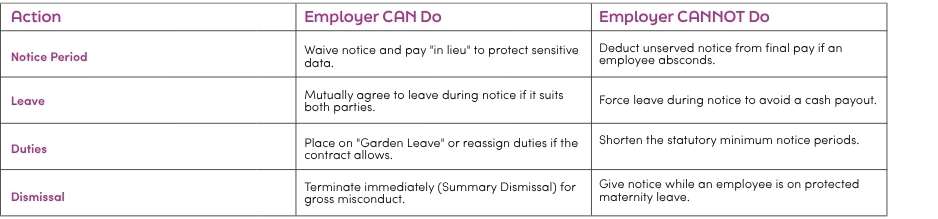
4. Dealing with "Desertion" and Early Exits
If an employee leaves without serving notice, it is a breach of contract. However, South African law is strict: you cannot unilaterally deduct the cost of the notice period from their final salary. To recover these costs, an employer must pursue a civil claim for damages, a process that is rarely practical for SMEs unless the financial loss is significant and provable. Reputation damage to the candidate for early exit is a risk they need to bear.
5. Ensuring a Seamless Transition
At RecruitMyMom, we understand that a resignation is the start of a new hiring cycle. By adhering to these legal notice requirements, you maintain your standing as an employer of choice and ensure your experienced professionals exit with their reputations and your business operations intact.
Can we help? Have you had a resignation? At RecruitMyMom, we assist with permanent hires (in-office and remote), maternity and sick leave fixed-duration hires, and independent contracting. Our flexible hiring solutions and talent base of over 250 000 job seekers help you solve talent problems fast.

