

Succession planning in any company, especially for SMEs, is not just about preparing to hand over; it’s about building a robust business that can grow beyond any single person. For many founders, the organisational-strengthening reframing changes everything. It moves succession planning off the someday list and onto the strategic agenda, where it has always belonged.
And yet, most SMEs have not successfully made the shift. Only 30% of family-owned businesses survive into the second generation, and 60% of South African SMEs have no formal succession plan. These figures are not meant as a warning, but as a valuable invitation to founders to start a conversation about the future.
Succession planning touches every part of a business worth protecting: your people, your team structure, your client relationships, your retention, and your long-term continuity. It is not a single conversation about one person stepping away, but an ongoing discipline that strengthens the entire business from the inside out.
Succession planning for small businesses is not only about retirement
The most common misconception about succession planning is that it belongs on the agenda only when you are ready to step away, leaving many SMEs exposed. The scenarios that test a business the most are rarely the ones you planned for.
A founder who is ill for three months, a senior manager who resigns without warning, a key account lead who burns out quietly and then leaves suddenly, a business partner who needs to step back for personal reasons: none of these is retirement, but all of them expose the same vulnerability. A business that has not thought carefully about what happens when a critical person is no longer available will feel the full weight of that gap, regardless of the reason.
Succession planning is a resilience strategy, and the SMEs that treat it as such are the ones that navigate disruption without losing momentum, client confidence or operational continuity.
What is the biggest risk to your company’s future?
Most founders do not set out to make themselves indispensable. It happens gradually, almost imperceptibly, as the business grows around their judgment, their relationships and their institutional knowledge, until one day the business simply cannot move without them.
This is the founder dependency problem, the most common succession risk in a small business. When the founder or a senior leader holds the primary client relationships, makes the key decisions and carries the memory of how and why things work the way they do, the exposure runs deep, even if it never appears on a balance sheet.
Asking yourself honestly what would happen if you were unavailable for six weeks tomorrow is an uncomfortable but revealing exercise. Which decisions would stall? Which client relationships would feel the strain? Which processes would unravel because they exist only in your head? These questions are uncomfortable because they are essential to the lifeblood of the business, and a well-considered succession plan begins with the willingness to answer them openly.
How to build a succession pipeline for your SME
Ask a simple question: if the person running this function left tomorrow, what would we do?
Building an internal talent pipeline does not require a formal HR function or a dedicated talent management framework; it only requires a candid look at each area of your business and one question: if the person running this function left tomorrow, what would we do?
Working through the answer to this question by function makes the risk tangible and the path forward clearer: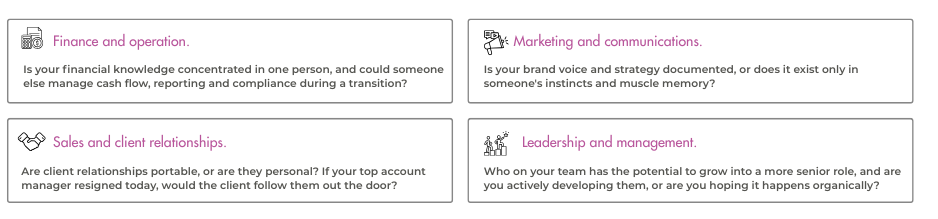
Identify the people you want to grow and tell them
This functional audit converts succession planning from an abstract concept into an actionable risk assessment, and it also surfaces something else useful: the people in your business who are ready for more responsibility, and the gaps where you are more exposed than you realise.
Once you have identified those people, the next step is the simplest and most overlooked one in most small businesses: tell them. A direct conversation with a high-performing team member that says "we see your future here and we want to invest in it" is one of the most powerful retention moves an SME leader can make, and it costs nothing beyond the willingness to have it.
Succession planning improves employee retention in SMEs
When your team members cannot see a future for themselves within your business, they start building one elsewhere, quietly and often without any warning signals until the resignation letter arrives.
Our 2026 Working Women in South Africa Report found that the lack of visible career progression is the single most cited reason skilled professionals consider leaving their current employer. People stay where they feel seen, developed and valued, and they leave when those conditions are absent, even if everything else about the role is good.
The cost of a bad hire is high enough on its own, but the cost of an avoidable resignation followed by a rushed replacement decision made under pressure compounds it considerably. Succession planning is, at its core, a retention investment, and when your people can see a path forward within your business, they have a compelling reason to stay on it.
How to use contract and flexible hiring to bridge succession gaps
Not every succession gap requires a permanent hire, and not every gap can be filled from within, which is why the most adaptable SME teams are built with both realities in mind: a core of permanent staff supported by contracted executives, and independent contractors who bring specialist capability when and where it is needed.
A good succession plan considers not only who could step into a role, but what that role should look like going forward and how it should be resourced. Some functions suit a permanent, full-time appointment, while others are better served by a contracted executive who provides senior leadership continuity during a transition, or by an independent contractor who holds a specialist function on a part-time or project basis while a longer-term decision is made carefully and without pressure.
When a key person leaves unexpectedly, flexible hiring gives an SME options that a rigidly permanent team structure does not have. A contracted executive can stabilise a senior function, maintain client confidence and protect operational continuity while you take the time to assess whether the role needs to be restructured, whether an internal candidate is ready to step up, or whether a permanent external hire is the right next step. That breathing room is often the difference between a considered decision and a costly one.
One of our clients successfully hired a fractional chief finance officer from RecruitMyMom to oversee and work alongside the finance team. This strategic move has enabled the business owner to rest well, knowing that if any member of his finance team is incapacitated, the part-time, contracted CFO will step in and help stabilise the ship, having gained knowledge along the way.
Beyond navigating an individual departure, building flexibility into your team structure from the outset is itself a form of succession planning. A business that is not wholly dependent on any single person or any single employment type is a more resilient business, one where roles can evolve, responsibilities can shift and leadership transitions can happen smoothly.
A manufacturing client has spent time with our team identifying the potential gaps should key members of staff fall ill or resign. Having identified the gap, we have been able to source a highly adaptable middle manager to move between functions as a catch-all in case something falls apart.
Three succession planning questions every SME owner should answer
Succession planning does not need to begin with a lengthy document or a boardroom review process. Starting with three honest questions is enough to understand where your greatest exposures lie and what your most important next steps are:
- Which roles in this business would cause the most disruption if vacated unexpectedly?
- Who on the team has the potential to step up, and what would they need to get there?
- Where are we most dependent on a single person, and how do we begin to reduce that exposure?
Succession planning is, in many ways, the ultimate act of confidence in what you have built and the people you have built it with.
RecruitMyMom helps SMEs find skilled professionals for permanent, contract and flexible roles across multiple functions and seniority levels. If you are thinking through a leadership transition or want to build a more resilient team structure for future succession planning, talk to our team.

