

For many businesses, paying an independent contractor by the hour feels like the simplest, fairest and most transparent option. You know what time has been worked, the contractor knows what will be paid, and everyone has a clear administrative record.
But there is a bigger question worth asking: are you paying for time, or for progress?
As you face increasing pressure to show measurable returns, paying for hours can sometimes distract from where value is actually created. A contractor may work diligently for ten hours, but if the business result is unclear, both parties will still be left wondering whether the work has moved the business forward.
On the other hand, paying purely for results can sound attractive, but it is not always practical, fair or easy to manage.
So, how should I pay a freelancer or an independent contractor?
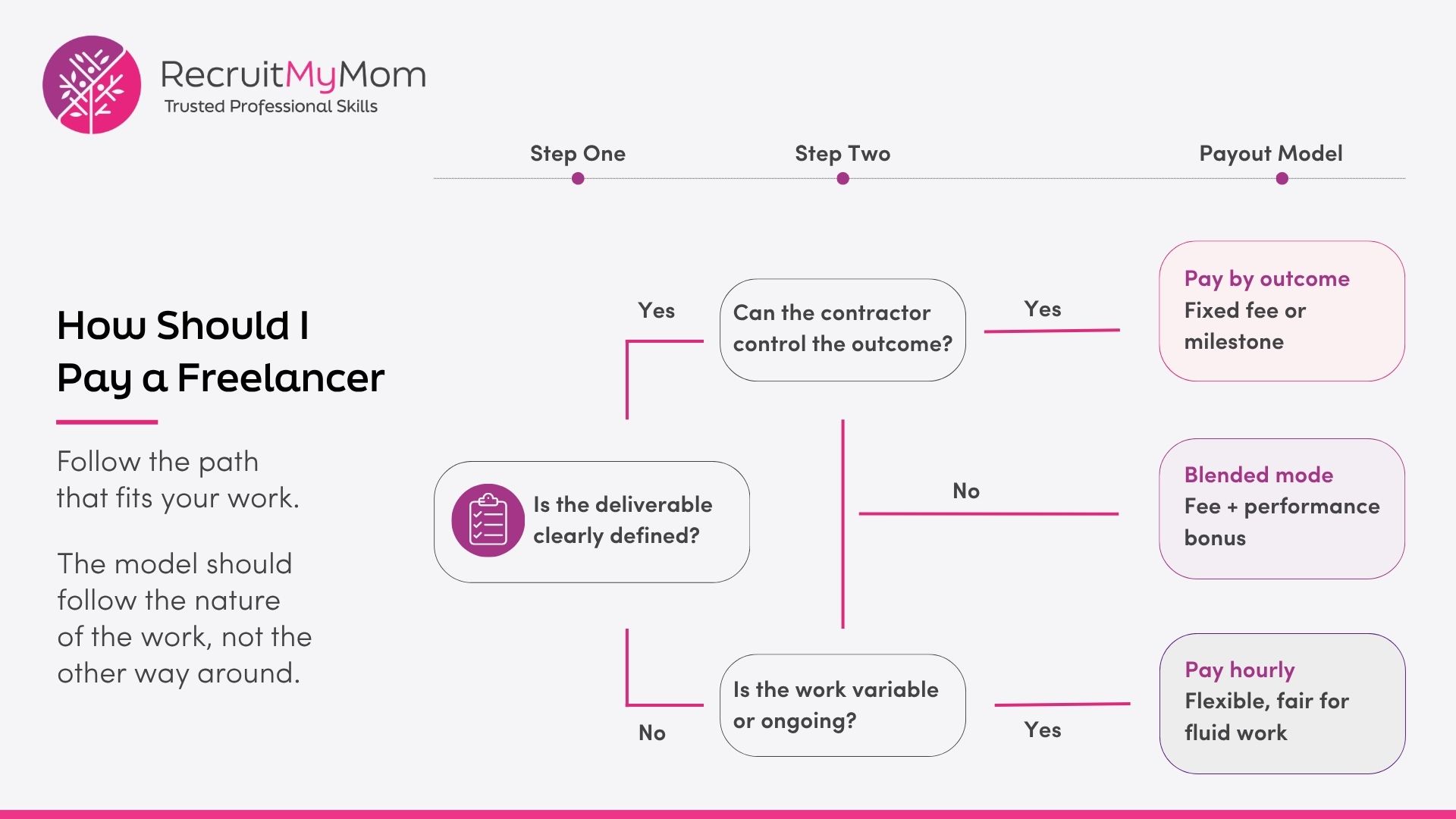
The answer depends on the nature of the work, the clarity of the expected outcome and the level of control you need.
Hourly payment works well when the work is ongoing, variable or difficult to define upfront. This is often the case with administrative support, finance assistance, project coordination, customer service, marketing implementation, or operational roles, where priorities shift throughout the month. In these situations, paying by the hour gives you, the client, flexibility and gives the contractor fair compensation for time spent responding to real business needs.
An hourly payment is also useful when you are still shaping the role. Many businesses know they need support, but they may not yet know exactly how much support or where the greatest value lies. An hourly arrangement allows both parties to learn and adjust.
Paying for outcomes or results may be more appropriate when the deliverable is specific, measurable and within the contractor’s control. Examples might include a completed report, a website migration, a recruitment campaign, a defined research project, a training programme or a set number of qualified leads. In these cases, the focus moves from activity to achievement.
However, outcome-based payment requires sound commercial judgement. The scope must be clear. The success measures must be agreed upon up front and dependencies must be understood. If a contractor’s ability to deliver depends on your approvals, internal systems, team availability or market conditions, then a results-only model can quickly become unfair or frustrating.
This is particularly relevant to hiring independent contractors in South Africa, where businesses often value the flexibility, expertise, and cost-effectiveness that RecruitMyMom’s independent professionals bring. The decision should be based on which model best supports trust, accountability, fairness and business impact.
As an aside, remote working raises a similar issue. When a person is not physically visible, it is tempting to measure time online. But visibility is not the same as value. Whether someone works remotely or on site, the better question is: what does good performance look like, and how will we know it has been achieved?
Real scenarios: when payment models become more complicated
Given our experience placing contractors across multiple disciplines and countries, we thought these scenarios might bring the complexity of the decision to life. We are adept at assisting clients in making these decisions.
Scenario 1: A fixed fee for content, but not all content works
A client appoints a content writer on a fixed project fee to produce ten pieces of content. Eight are strong and usable, but two do not meet the agreed standard.
This is where outcome-based payment needs careful upfront definition. A fixed project fee should not only state the number of pieces to be delivered. It should also define what “approved” or “usable” means, how many revision rounds are included, who gives feedback, and what happens if a piece does not meet the agreed-upon brief.
If the two weaker articles are off brief, factually inaccurate, poorly structured or not suitable for the intended audience, the client should be able to request revisions within the agreed scope. If the contractor has followed the brief, but the client’s expectations have changed, additional rewriting may need to be treated as extra work.
A fair approach could be to structure the project around milestones: brief approval, first draft, revision and final sign-off. This protects both parties. The client is not left paying in full for work that cannot be used, and the contractor is not exposed to open-ended revisions or subjective dissatisfaction.
The lesson is clear: a fixed fee does not mean vague accountability. It requires sharper briefing, clearer approval criteria and agreed revision terms.
Scenario 2: A virtual assistant supporting a busy leadership team
A company appoints an Independent Contractor as a virtual assistant to support diary management, inbox coordination, travel arrangements and meeting preparation. The workload changes from week to week. Some weeks are intense, while others are quieter.
In this case, paying purely for outcomes would be difficult. The value lies in responsiveness, availability, judgement and the ability to handle changing priorities. An hourly rate is likely to be the fairest model because the contractor is giving time, attention and flexibility to the client.
However, this does not mean the arrangement should be loose. The client can still agree on expected response times, core working hours, reporting methods and priority tasks. Paying by the hour should not remove performance expectations. It simply recognises that the work is fluid and cannot always be packaged neatly into fixed deliverables.
Scenario 3: A marketing contractor managing a lead generation campaign
A business appoints a marketing contractor to run a three-month lead generation campaign. The client is tempted to pay only for the number of leads generated.
At first glance, this sounds commercially sensible. But lead generation depends on several factors outside the contractor’s control, including the strength of the offer, the advertising budget, the website conversion journey, the target market, brand awareness and how quickly the client follows up.
A more balanced model might include a fixed monthly project fee for the work performed, with a performance bonus linked to agreed results. The contractor is paid for the strategic and operational work required, while the client continues to create an incentive for measurable outcomes.
This blended model works well when the contractor can influence results, but does not control every variable.
These scenarios show why the payment model should follow the nature of the work, not the other way around. Some roles need flexibility. Some projects need defined deliverables. Others need a blended approach that recognises both effort and results.
At RecruitMyMom, we help clients think through these important decisions before they appoint an Independent Contractor. Some roles are best suited to an hourly payment. Others can be structured around milestones, deliverables or outcomes. Many require a blended approach.
The most successful arrangements are effective when expectations, measures and ways of working are explicit from the start. When this clarity is in place, clients and contractors can focus on work that contributes directly to business performance.
Frequently Asked Questions
How should I pay a freelancer?
The best way to pay a freelancer depends on the type of work, the clarity of the deliverables, and the level of flexibility the business needs. Hourly payment works well for ongoing, changing or support-based work. Outcome-based payment is better suited to clearly defined projects with measurable deliverables.
Should I pay an Independent Contractor by the hour?
You should consider paying an Independent Contractor by the hour when the work is variable, difficult to scope upfront or dependent on changing business priorities. This model is often useful for administrative, financial, operational, marketing and project support roles.
When should I pay a freelancer for results?
Paying a freelancer for results works best when the outcome is specific, measurable and largely within the contractor’s control. This may include a completed project, a defined campaign, a report, a system implementation or a set of agreed deliverables.
Is it better to pay for hours or outcomes?
Neither model is automatically better. Paying for hours offers flexibility and transparency, while paying for outcomes can create stronger alignment around business results. The right choice depends on the nature of the work, the level of certainty and the risks carried by both the client and contractor.
What is outcome-based payment?
Outcome-based payment means paying an Independent Contractor for an agreed result or deliverable rather than for the number of hours worked. For this model to work well, the scope, success measures, timelines and dependencies should be agreed upon before the work begins.
What should employers consider when using Independent Contractors in South Africa?
When considering Independent contracting in South Africa, employers should carefully consider the nature of the relationship, the scope of work, the payment structure, accountability, timelines, and whether the contractor has the independence expected in an independent contracting arrangement. Clear agreements help both parties work with confidence.
Can remote freelancers be paid by results?
Yes, remote freelancers can be paid by results when the work is clearly defined, and the deliverables can be measured. Remote work should not rely only on online visibility or hours logged. A well-structured agreement should define what successful delivery looks like.
How can RecruitMyMom help employers appoint Independent Contractors?
RecruitMyMom helps employers assess the role, define the scope of work and consider whether an hourly, milestone-based or outcome-based arrangement is most appropriate. This supports better matching, clearer expectations and more effective working relationships between clients and Independent Contractors.
Need help deciding whether to pay an Independent Contractor by the hour, by milestone or by outcome?
RecruitMyMom can help you define the role, scope the work and find experienced professionals suited to your business needs.

