

If you need to find vetted professional talent in South Africa, a strong recruitment process involves far more than finding someone with the right job title on their CV. It means establishing whether the candidate has the experience and capability required for the role, checking important information they have provided and, where appropriate, carrying out relevant background verification before you make the appointment.
South Africa has a substantial pool of qualified and experienced professionals across finance, marketing, sales, HR, operations, administration, customer support, technology and many other disciplines. The challenge for employers is often not finding applicants. It is identifying the right people from a large pool and doing enough due diligence to make an informed hiring decision.
Here is what to consider.
What does vetted professional talent actually mean?
There is an important distinction between screening a candidate and completing formal verification checks.
Professional candidate screening may include:
- reviewing the CV against the requirements of the role
- interviewing the candidate
- assessing relevant experience and achievements
- exploring technical and behavioural competencies
- discussing salary expectations, availability and working arrangements
- conducting employment reference checks
- assessing whether the person's experience and expectations align with the position.
Formal verification checks are different. Depending on the role, these could include identity, qualification, criminal, credit, fraud, driver's licence or employment history verification.
Not every candidate needs every check.
In fact, good recruitment practice is to choose checks based on the responsibilities and risks attached to the position rather than applying the same list indiscriminately to every applicant.
Start with a clear definition of the talent you need
Before searching for candidates, clarify what the person really needs to be able to do. A long job description containing every desirable characteristic can narrow your talent pool unnecessarily. Instead, separate your requirements into:
Essential requirements: experience, qualifications or capabilities without which the person cannot perform the role. Start by answering the question: what will the person be doing 80% of the time?
Preferred requirements: experience that would add value but could potentially be learnt.
Role outcomes: what the person needs to achieve during their first three to six months.
This also makes candidate vetting more meaningful. Rather than asking whether someone looks impressive on paper, you can assess whether their experience shows evidence that they can deliver what your business requires.
Use interviews to verify the experience claimed, not simply repeat the CV
A good professional interview should add context to the information on the candidate's CV.
Ask candidates for specific examples of work they have done, decisions they have made and problems they have solved.
For example, instead of asking:
"Do you have budgeting experience?"
Explore:
"What size budget were you responsible for, what decisions did you make, and what reporting responsibility did you hold?"
For a marketing candidate, discuss campaigns, channels, budgets, results and their individual contribution.
For an operations candidate, explore processes they improved, teams they managed and the complexity of the environment.
For a senior finance candidate, establish the extent of their financial management, reporting, governance and strategic responsibilities.
The purpose is not to catch a candidate out. It is to understand the depth of their experience.
Check employment references carefully
Reference checking remains one of the most useful elements of candidate verification.
Where possible, speak to someone to whom the candidate reported directly rather than relying solely on a written reference supplied by the candidate. Written references can often be fraudulent, so call or email the person who wrote the reference to verify it.
A useful reference conversation can confirm:
- dates of employment
- position and responsibilities
- reporting relationships
- the level at which the candidate operated
- strengths and areas for development
- reliability and working style
- reason for leaving
- whether the referee would employ the person again.
References also help employers distinguish between experience a candidate was exposed to and work for which they personally held responsibility.
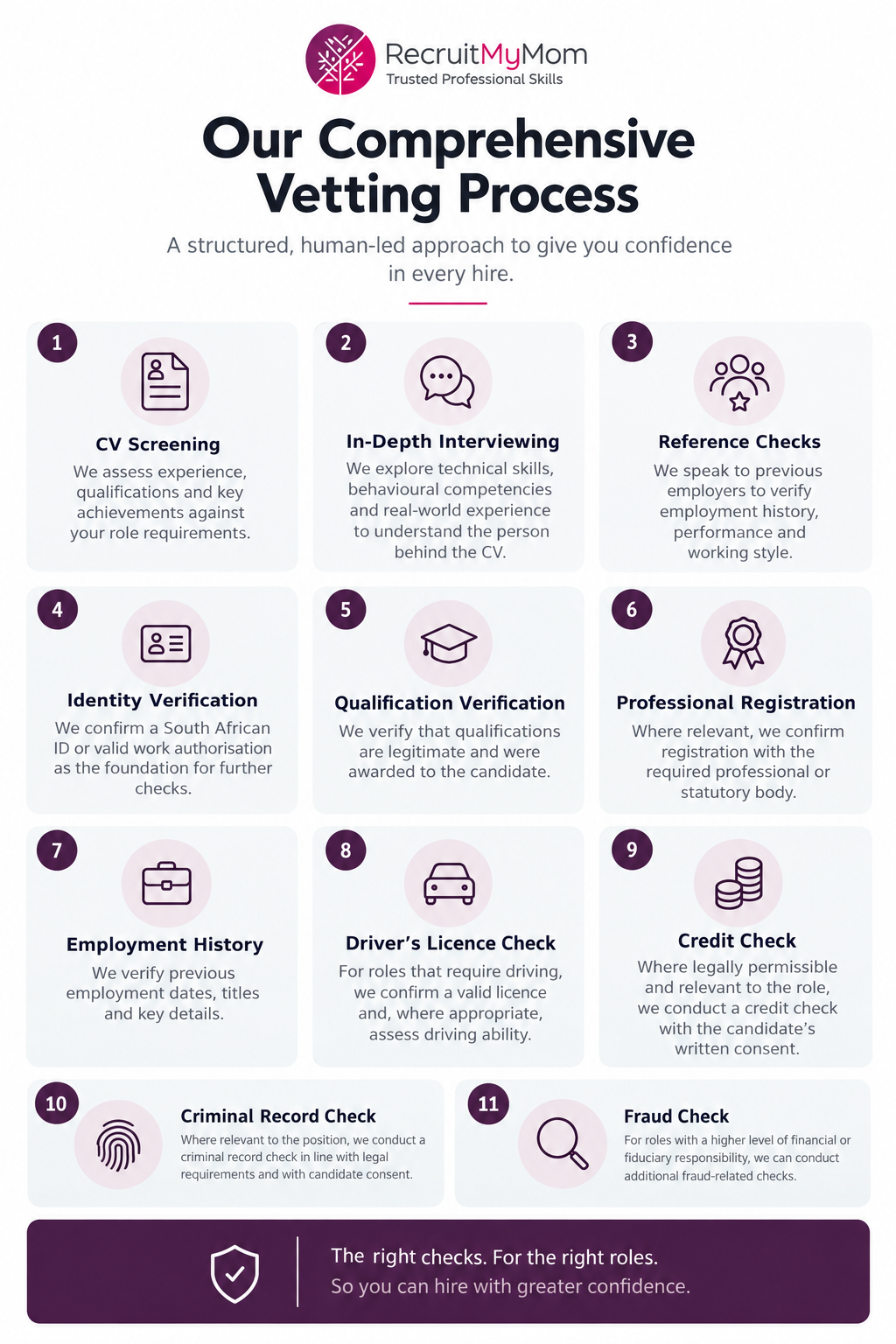
Which common background checks can South African employers consider?
The appropriate checks will depend on the position.
Common South African pre-employment checks include:
Identity verification
Confirming a South African ID or other appropriate identity documentation provides an important foundation for subsequent verification.
Where applicable, employers also need to establish that a candidate has the legal right to work in South Africa.
Qualification verification
Where a qualification is required for the position, verify that it is legitimate and was awarded to the candidate concerned.
This becomes particularly important for regulated occupations and roles where a particular professional qualification forms part of the hiring criteria.
The National Qualifications Framework legislation provides mechanisms for the verification of South African qualifications and for identifying misrepresented or fraudulent qualifications.
Professional membership or registration
For regulated professions, verify relevant professional registrations where these are required.
Depending on the role, this could include registration with a professional accounting, engineering, healthcare or other statutory or industry body.
Employment history
For positions where previous experience is central to the hiring decision, employers can verify employment dates, titles and other relevant information rather than relying exclusively on the CV.
Driver's licence verification
If driving forms an essential part of the job, a driver's licence check is appropriate. Bringing the person to your grounds and testing their driving skill is recommended.
Fraud checks
Certain positions carrying a high level of financial, fiduciary or organisational responsibility may warrant additional fraud-related screening.
Criminal record checks
A criminal record check can be appropriate for certain positions, but it should not simply become an automatic requirement for every employee.
The relevance of the check should be considered in relation to the position, and the information must be processed lawfully and fairly. Candidate consent and POPIA considerations are an important part of the process.
For example, the risk considerations for someone working with vulnerable people, valuable assets, sensitive information or substantial financial responsibility may differ significantly from those of another position.
We explain the South African considerations in more detail in our guide to being on the right side of POPIA with criminal, credit and background checks. Read RecruitMyMom's guide to criminal, credit and background checks
Our pre-employment candidate checks guide also explains the different verification checks available and when they may be relevant. Read the pre-employment candidate checks guide
Be particularly careful with credit checks
An employer cannot request a credit report simply because it would like to know how a prospective employee manages their personal finances.
South Africa's National Credit Regulations limit employment-related credit enquiries. They allow a credit report for a position requiring trust and honesty and involving the handling of cash or finances, with the candidate's specific written consent.
This could make a credit check relevant for certain finance or cash handling positions, but not for an unrelated role simply because an employer prefers candidates to have a clear credit history.
RecruitMyMom has written specifically about when an employer can request a credit check on a job seeker in South Africa. Read when an employer can request a credit check
Match the checks to the role
A useful principle is: verify what is relevant to the appointment you are making.
For an accountant, that may mean qualifications, professional registration, employment references and, where the legal requirements are met, a credit check.
For a salesperson who travels extensively, identity, employment references and driver's licence verification may be more relevant.
For a marketing specialist, references and evidence of previous work or campaign results may tell you considerably more than a credit report ever could.
For a senior executive, you may want a more extensive combination of reference, qualification, identity, employment history and other appropriate checks.
The objective is proportionate due diligence rather than maximum checking.
Don't overlook career breaks when assessing professional talent
A career break does not automatically indicate that a candidate has lost their professional capability.
RecruitMyMom's Working Women in South Africa research found that 43% of women surveyed had taken a career pause, most commonly because of childcare, retrenchment or family responsibilities, and 94% of those women had returned to work.
For an employer looking for experienced South African talent, automatically screening out candidates with career gaps can therefore remove highly capable people from consideration.
Look at the person's complete career history, how relevant their skills remain and what they have done to keep their knowledge current.
Consider a wider range of employment models
Finding the right professional does not always mean filling a traditional full-time, permanent position.
Depending on what your business needs, South African professionals can be engaged through permanent employment, fixed-term contracts, independent contracting, fractional appointments or other flexible arrangements.
A growing business, for example, may need experienced financial leadership but not yet require a full-time CFO. Another may need a marketing specialist for a six-month project. An established organisation may need maternity cover or a permanent employee who works partly from home.
Defining the role around the work that needs to be done will widen the calibre of people available to you as well as ensure you attract the right person.
How RecruitMyMom helps employers find professional South African talent
RecruitMyMom is a South African recruitment company established in 2012, with a talent network spanning numerous professional disciplines and career levels. We recruit for permanent, fixed-term, independent contractor, fractional, remote, hybrid and office-based positions.
Our recruitment team helps employers define their requirements, source suitable professionals, screen and interview candidates and conduct reference checks.
Relevant verification services are also available, including identity, qualification, criminal, credit, fraud and driver's licence checks. Which checks are carried out depends on the position, the employer's requirements and the legal basis for conducting them. RecruitMyMom's terms specify that credit and criminal checks are undertaken where legally permissible and with candidate consent, while additional verification checks can be requested where relevant.
This is an important distinction.
Recruitment cannot remove every hiring risk, and no responsible recruitment company can guarantee how somebody will perform once employed. What a considered recruitment and verification process will do is give an employer better information on which to base the hiring decision.
Finding vetted talent is ultimately about better evidence
The best way to find vetted professional talent in South Africa is not to run the most checks or collect the most CVs. It is to understand what your business needs, assess candidates against those requirements, verify the information relevant to the appointment and complete appropriate background checks before making the final hiring decision.
That combination of professional recruitment judgement and sensible verification gives employers a far stronger basis for choosing the person they believe is right for the role.
RecruitMyMom helps South African and international employers source skilled South African professionals across permanent and flexible employment models.
If you are looking for professional talent for your business, contact our recruitment team about the skills, experience and working arrangement you need.

