

Why pay for a full-time executive salary when your business only requires ten hours of high-level strategy per week? You likely feel the weight of rising employment costs and the persistent challenge of finding vetted talent who can contribute from day one. It's a common tension; you need a CFO-level brain to navigate complex growth, yet you can't justify the overhead of a traditional, forty-hour contract. Learning how to hire a part-time professional allows you to bridge this gap without compromising on the quality of your leadership or the speed of your delivery.
We understand that modern business requires agility rather than just more hours. This article provides a strategic framework to secure elite expertise through flexible roles that drive growth whilst protecting your bottom line. You'll discover how to identify fractional needs, integrate part-time staff into your existing team culture, and scale your workforce with precision. By the end of this guide, you will possess the tools to build a high-performance team that adapts to the demands of 2026 with confidence and ease.
Key Takeaways
Discover why modern businesses favour agility over traditional structures to maintain a competitive edge in the 2026 economy.
Identify the difference between expertise gaps and capacity gaps to ensure every fractional hire delivers the highest possible return.
Understand the process of how to hire a part-time professional by focusing on clear, output-based performance metrics.
Access high-calibre candidates through specialised networks and rigorous vetting processes that guarantee skills and cultural fit.
Learn to create a seamless onboarding experience that integrates flexible professionals into your team culture for long-term business continuity.
Understanding the Strategic Shift Towards Part-Time Professional Talent
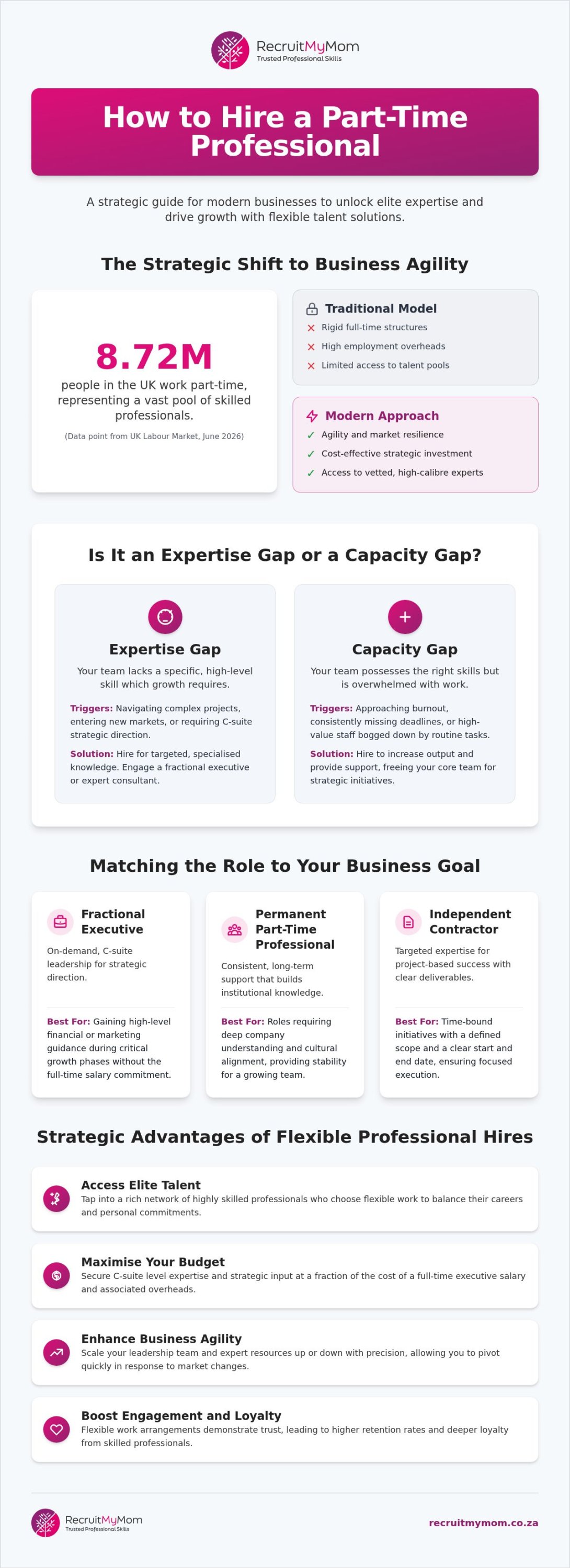
The definition of a part-time professional has evolved significantly within the 2026 economic climate. Businesses now prioritise agility over rigid, full-time structures to maintain resilience. The UK labour market reflects this shift, with 8.72 million people working part-time as of June 2026. This trend represents more than a change in hours; it signals a movement towards specialised, high-impact contributions. While a standard part-time employment definition focuses on working fewer hours than full-time colleagues, the professional part-time worker brings years of corporate experience to a specific project. You aren't simply filling a seat. You are securing a strategic advantage. Modern leaders now seek to understand how to hire a part-time professional to manage overheads without sacrificing growth.
There is a clear distinction between casual labour and high-level fractional expertise. Casual labour typically involves task-based, unskilled work. High-level fractional expertise, however, provides the strategic leadership your business needs to scale. Flexible models empower you to access talent that previously felt out of reach due to budget constraints. You can now engage a seasoned expert for two days a week, gaining the same intellectual capital as a large corporation at a fraction of the cost.
The Rise of the Fractional Executive
Startups and SMEs often require the strategic mind of a veteran leader but lack the budget for a permanent executive salary. This is where fractional talent changes the game. Whether you need a fractional CFO to navigate a complex funding round or a CMO to overhaul your digital presence, you can access this leadership on an on-demand basis. On-demand leadership provides the agility to pivot quickly when market conditions change. It allows you to scale your management team as demand fluctuates, ensuring you pay only for the value you receive.
Addressing the Talent Gap with Flexible Professionals
The talent landscape shifted when approximately one-third of employers reported hard-to-fill vacancies in early 2026. Highly skilled professionals, particularly professional women, often choose part-time paths to balance high-level careers with personal commitments. This vetted network offers a wealth of experience that bridges the skills gap effectively. By embracing flexibility, you gain access to a talent pool that prioritises impact over presence. You eliminate the burden of full-time overheads whilst ensuring your business benefits from precise, expert execution. Skilled professionals appreciate the trust you place in them, which often leads to higher retention and deeper loyalty.
Evaluating Your Business Needs: Fractional Talent vs. Traditional Roles
Before you begin the recruitment process, you must distinguish between an expertise gap and a capacity gap. An expertise gap arises when your current team lacks a specific high-level skill, such as advanced financial modelling or strategic brand positioning. Conversely, a capacity gap occurs when your existing staff simply have too much work. Identifying this distinction ensures you don't overspend on a full-time hire when a targeted, professional part-time role provides a better return on investment. Learning how to hire a part-time professional begins with this clear audit of your internal requirements. Understanding the benefits of hiring fractional executive talent allows you to inject senior-level wisdom into specific projects without the long-term commitment of a traditional salary. This strategic approach helps you scale efficiently whilst maintaining high standards of performance.
When to Choose a Permanent Part-Time Professional
Certain roles require a deep understanding of your company's history and a strong alignment with your core values. Permanent part-time staff provide the stability a growing team needs to thrive. These professionals build long-term institutional knowledge, which remains within the business even as projects evolve. You gain a dedicated team member who feels a sense of ownership over the goals towards which you strive. In South Africa, you must ensure your contracts comply with local labour laws, providing pro-rata benefits that reflect the hours for which they are contracted.
Utilising Independent Contractors for Project-Based Success
When you face a time-bound deliverable with a clear start and end date, vetted independent contractors offer the ultimate flexibility. These specialists focus on high-impact tasks without requiring a long-term commitment from the business. They drive agility within your internal departments by bringing fresh perspectives and specialised tools to the table. This model works exceptionally well for technical implementations or seasonal marketing campaigns where you need intense focus for a limited duration. You manage the output rather than the clock, ensuring every cent spent contributes directly to the project's success.
Choosing the right model depends entirely on the specific challenges your business currently faces. Whether you need a virtual assistant to handle administrative flow or a fractional leader to guide a department, the right fit exists within a flexible framework. If you feel unsure about which model suits your current growth phase, you can discuss your specific requirements with a talent specialist to find the most effective path forward.
Defining the Scope and Structure of a Professional Part-Time Role
Success in the flexible economy depends on how you define the role from the outset. You must move away from the traditional model of paying for presence and instead focus on value and deliverables. When you research how to hire a part-time professional, you'll find that high-calibre experts prioritise impact over desk-time. Crafting a job description that speaks to this elite talent requires a shift in language. Focus on the strategic problems they will solve rather than a list of repetitive tasks. By clearly outlining the outcomes you expect, you attract individuals who take ownership of their contributions. This clarity builds a foundation of trust, which remains essential for any non-traditional working arrangement.
Setting clear expectations regarding communication and availability prevents future friction. You must decide whether the professional needs to attend weekly sync meetings or if they can contribute asynchronously. Don't treat your part-time professional as an outsider. Invite them to team-building events and include them in high-level strategy discussions. When a professional feels like a core team member, their commitment to the organisation grows. This sense of belonging drives the long-term success of your flexible workforce and ensures business continuity.
Designing the Ideal Work Schedule
Will the role be hybrid, fully remote, or on-site? In the South African context, many professionals prefer a hybrid model that balances the convenience of working from home with the social connection of the office. Establishing 'core hours' ensures your team can collaborate effectively without sacrificing individual flexibility. You might decide that everyone must be online between 10:00 and 14:00 on specific days for collaboration. This structure provides the predictability your business requires whilst honouring the professional’s need for the autonomy for which they long. Balancing these needs creates a sustainable environment for everyone involved.
Setting Measurable Goals for Part-Time Staff
Accountability thrives when you set clear Key Performance Indicators (KPIs) that align with your business objectives. For a fractional executive, these might include specific revenue targets or the completion of a digital transformation project. Utilise technology like Slack for communication and Asana or Trello for project tracking to maintain visibility. These tools ensure that progress remains transparent, even when team members work at different times. By focusing on results, you empower your part-time staff to manage their own schedules effectively whilst meeting the deadlines for which you hired them.
Executing a Robust Recruitment Process for Skilled Part-Timers
Generic job boards often overwhelm hiring managers with high volumes of unsuitable applications. When you investigate how to hire a part-time professional, you'll find that the most successful placements come from specialised networks. These platforms focus specifically on the flexible economy, attracting individuals who value autonomy and high-impact work. Accessing the hidden talent pool of experienced professional moms allows you to secure skills that generic sites often overlook. A national search for remote-capable roles expands your reach, ensuring you find the perfect cultural and technical fit regardless of geography.
Sourcing the Right Talent
Specialised agencies outperform general platforms because they understand the nuances of fractional and part-time roles. They maintain a vetted network of professionals who have already proven their ability to deliver results outside of traditional structures. This proactive approach saves you time and reduces the risk of a poor hire. By partnering with experts who specialise in this niche, you gain access to a calibre of talent that prioritises meaningful work over a standard forty-hour week.
The Vetting and Interview Process
Vetting for a part-time role requires a focus on 'flexibility fitness' and self-management. You need to know if a candidate can maintain momentum without constant supervision. During the interview, ask questions that reveal their ability to work independently:
How do you prioritise deliverables when working across multiple projects?
What tools do you use to ensure seamless communication with a remote team?
Can you provide examples of how you managed a project's scope within limited hours?
Verifying past performance in flexible capacities ensures the candidate possesses the discipline required for this model. Cultural alignment remains just as critical for a part-timer as it does for a full-time executive. You must ensure the candidate aligns with your values during the interview stage.
Structuring the Offer and Contract
Professionals in this space often value time and flexibility as much as their salary. When you structure the offer, include clear clauses regarding flexible work arrangements and core collaboration hours. Define notice periods and renewal terms specifically for independent contractors to ensure both parties feel secure. These professional standards protect your business whilst empowering the individual to perform at their best.
If you need assistance navigating this specialised recruitment landscape, you can reach out to our team for expert guidance on finding your next high-level hire.
Onboarding and Integrating Flexible Professionals for Long-Term Success
Integrating a high-level specialist into your organisation requires more than just a welcome email. You must view the onboarding phase as a critical investment in your company's future culture. Whilst many leaders understand how to hire a part-time professional, many fail during the integration stage. You should provide clear access to internal documentation and digital tools from the first day. This proactive approach ensures your new hire feels valued and ready to contribute immediately. You might also consider utilising executive virtual assistant services to handle administrative tasks for your part-time leaders. This allows your fractional experts to focus entirely on the high-level strategy for which you hired them.
Building a culture of inclusion for non-full-time employees prevents the feeling of isolation that remote or part-time staff sometimes experience. You should invite them to participate in relevant team meetings and social events, even if they join via video link. This sense of belonging drives engagement and ensures that your flexible workforce remains aligned with your long-term vision. When people feel like core members of the team, they produce their best work.
Effective Communication Strategies
Successful collaboration with a flexible workforce relies on robust digital infrastructure. You must choose platforms that facilitate asynchronous work, such as project management software or shared document centres. Scheduling regular check-ins remains vital, but you should respect the professional’s contracted hours. Avoid the temptation to send messages during their time off. Instead, use scheduled messages or email to ensure they remain informed of company shifts without feeling pressured to respond outside their agreed schedule. This boundary-setting fosters mutual respect and maintains high engagement levels amongst your team.
Building Trust and Empowerment
Micromanagement often stifles the very agility you sought when choosing a flexible model. You should transition towards trust-based leadership, where you measure success by output rather than hours logged. Publicly recognise the contributions of your part-time professionals during general staff meetings or within internal newsletters. When you foster a supportive environment, you build long-term loyalty that transcends the traditional employment contract. This empowerment encourages professionals to take ownership of their roles, leading to the sustainable growth of your business.
Embracing a Future of Flexible Excellence
The professional landscape of 2026 demands a departure from rigid structures. You don't need a full-time contract to secure world-class expertise. You now possess a strategic framework to transform your workforce by prioritising output and specialised talent. By auditing your business needs and defining roles based on deliverables, you secure high-level skills that scale with your ambition. Understanding how to hire a part-time professional empowers you to access elite leadership whilst protecting your bottom line. This shift towards agility ensures your organisation remains resilient in a fluctuating market.
Since 2012, RecruitMyMom has pioneered flexible work-life integration as an award-winning South African agency. Our vetted network of thousands of skilled professionals ensures you find the precise expertise your project requires. We specialise in both fractional and permanent recruitment, offering the meticulous vetting your business deserves. Discover how RecruitMyMom can help you hire your next part-time professional today. We look forward to supporting your journey towards a more agile and human-centric future.
Frequently Asked Questions
What is the legal definition of a part-time employee in South Africa?
South African labour law does not define a specific number of hours for part-time work. You consider an employee part-time if they work fewer hours than a comparable full-time colleague within your organisation. The principle of equal treatment ensures these workers receive pro-rata benefits and fair treatment. You must provide the same access to training and opportunities as your full-time staff enjoy.
How do I calculate a fair salary for a fractional professional?
You calculate a fair salary by determining the full-time market rate for the role and applying it pro-rata to the contracted hours. Fractional executives often command a slightly higher hourly rate due to the high-level strategic value they provide. This approach ensures you pay for impact rather than just time. Understanding how to hire a part-time professional involves balancing competitive remuneration with the flexibility your business offers.
Can a part-time professional effectively manage a full-time team?
Professional part-time leaders manage full-time teams effectively by establishing clear communication channels and core collaboration hours. They focus on empowering their direct reports through trust-based leadership and measurable outcomes. You must ensure the team understands the manager's availability and uses asynchronous tools to maintain momentum. This model fosters a culture of independence and accountability within the department. Success depends on the quality of leadership rather than the hours of presence.
What are the primary differences between a part-time employee and a contractor?
A part-time employee works under a contract of service and receives pro-rata benefits such as paid leave and sick pay. You deduct PAYE from their salary according to South African tax regulations. An independent contractor operates under a contract for services and manages their own tax affairs. Contractors provide specific deliverables over a set period without the long-term commitment that an employment contract requires. Choosing the right model depends on your business goals.
How do I ensure data security when hiring remote part-time staff?
You secure your business data by implementing multi-factor authentication and using encrypted cloud-based platforms for all collaboration. Require your remote staff to sign comprehensive non-disclosure agreements before they access sensitive information. Providing a secure VPN ensures that all digital interactions remain protected from external threats. You should also conduct regular security training to ensure every team member understands the protocols to which they must adhere.
What should I include in a maternity leave cover contract?
Your maternity leave cover contract should include a specific fixed-term duration and a clear list of deliverables. Outline the handover process at the beginning and the end of the placement to ensure business continuity. You must include clauses that address the return of the permanent employee and any potential extension requirements. Specifying the expected hours and communication protocols helps the vetted professional integrate quickly into the existing team structure.
Why is a specialised recruitment agency better than LinkedIn for part-time roles?
Specialised agencies like RecruitMyMom provide access to a vetted network of thousands of skilled professionals that you won't find on generic platforms. We have refined our expertise in fractional and permanent recruitment since 2012, ensuring a high-quality match for your specific culture. LinkedIn often produces a high volume of unvetted applications that consume your valuable time. Knowing how to hire a part-time professional involves partnering with experts who handle the deep vetting for you.
How do I handle the onboarding of a professional who works only two days a week?
You handle the onboarding of a two-day-a-week professional by creating a central digital hub for all training materials and project updates. Record essential team meetings so the part-time staff member can catch up on discussions during their working hours. Ensure they have full access to all necessary software and communication tools before their first day. This proactive preparation allows them to contribute immediately without waiting for administrative approvals or information.

