

As South African organisations navigate the complexities of a modern workforce, mastering the art of hybrid team management has become less a trend and more a fundamental requirement for sustainable success. The challenge lies not in simply allowing employees to work from home, but in architecting a deliberate framework that fosters productivity, preserves culture, and ensures operational resilience. For many leaders, the transition has raised critical questions: How do you maintain fairness between on-site and remote team members? How can you track performance without resorting to micromanagement? This guide provides a strategic blueprint, moving beyond generic advice to offer practical, context-aware best practices specifically for South African leaders who aim to build and manage high-performing hybrid teams.
The Evolution of Hybrid Work in South Africa for 2026
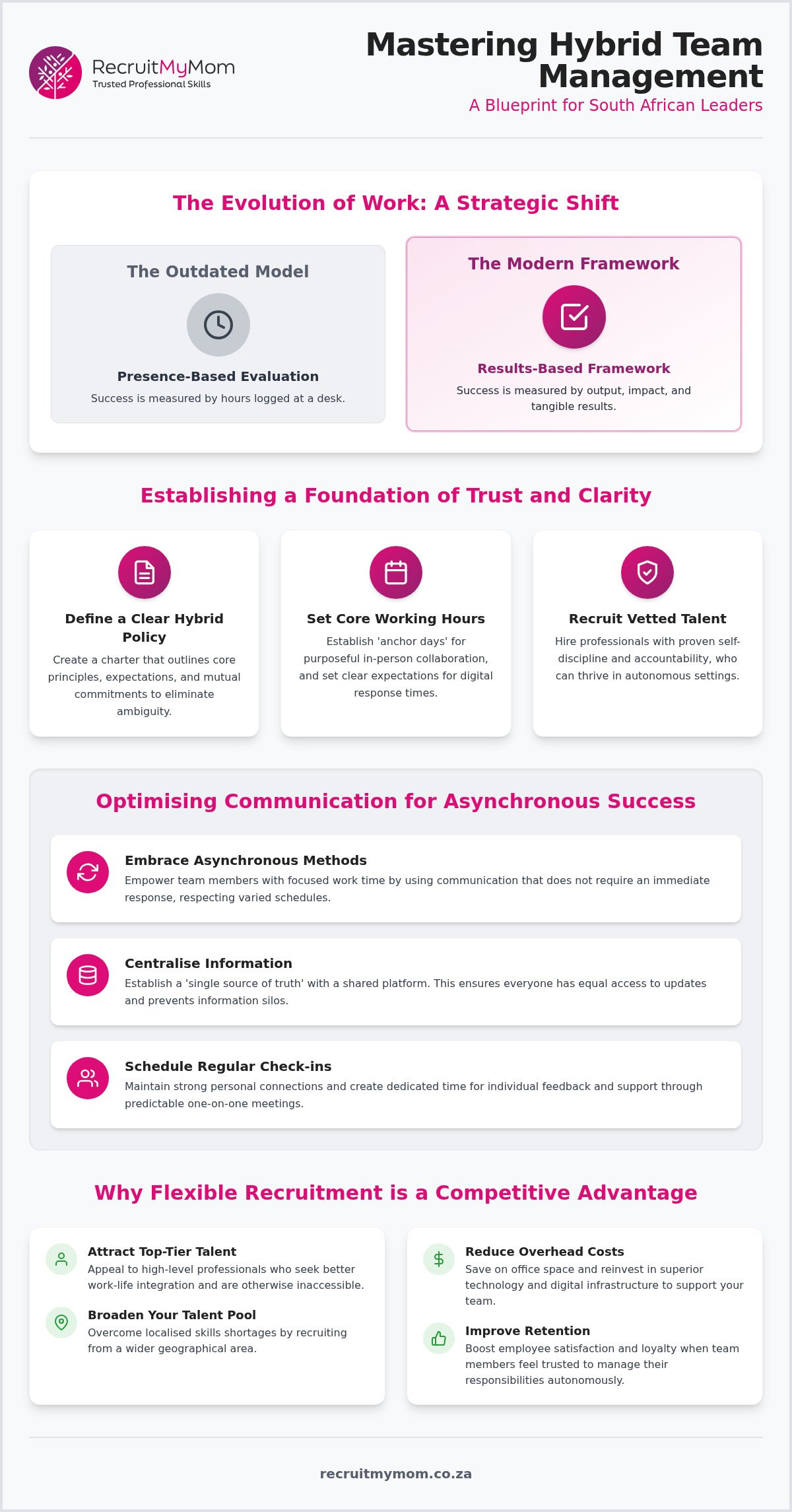
The working landscape in South Africa has fundamentally shifted, with hybrid work models moving from a temporary measure to a permanent strategic choice for future-thinking organisations. This evolution is not only about location; it represents a deeper change in how we perceive work, productivity, and talent acquisition. As detailed in the "Working Women in South Africa Report 2026, " there is a clear and growing demand amongst skilled professionals for roles that offer greater flexibility. Employers who skilfully integrate hybrid models position themselves to attract and retain top-tier talent by moving from rigid "presence-based" evaluations to more effective "results-based" frameworks that prioritise output and impact.
Why Flexibility is a Competitive Advantage
In a competitive market, offering flexibility is a powerful differentiator. When recruiting for hybrid roles in South Africa, organisations discover they can attract high-level professionals who seek better work-life integration and are otherwise inaccessible. This model allows businesses to tap into a wider talent pool within a commutable radius, bringing in individuals who may not be available for a traditional five-day office week. Furthermore, a well-managed hybrid strategy can lead to reduced overhead costs associated with office space, allowing for strategic reinvestment in superior technology and digital infrastructure. When employees feel their organisation trusts them to manage their responsibilities autonomously, it can significantly improve employee satisfaction and retention rates.
Addressing the Workforce Squeeze
South Africa faces a pronounced workforce squeeze, with a notable shortage of specialised skills in various sectors. The most sought-after professionals often have multiple employment offers and increasingly prioritise roles that provide hybrid or remote arrangements. By offering a structured hybrid model, your organisation immediately becomes more appealing to this discerning talent pool. This approach helps overcome localised skills shortages by broadening the geographical area from which you can recruit. Flexible staffing solutions, such as leveraging independent contractors or fractional executives for specific projects, also provide essential agility, enabling your business to adapt swiftly to economic fluctuations without committing to the overheads of permanent hires.
Establishing a Foundation of Trust and Clear Expectations
The success of any hybrid team is built not on technology, but on a deliberate and consistently nurtured culture of trust. This foundation prevents the common pitfalls of hybrid work, such as communication breakdown, perceived inequality, and declining morale. It begins with creating absolute clarity. Your first step is to define precisely what "hybrid" means for your organisation, as ambiguity is the primary source of frustration. From this definition, you must draft a comprehensive Hybrid Work Policy. This document is a charter that outlines core principles, expectations, and mutual commitments. Critically, this policy should shift the focus from hours logged at a desk to the measurable outcomes and tangible results your team delivers.
Defining Core Working Hours and Availability
A common challenge in hybrid management is coordinating collaboration. To address this, many organisations establish "anchor days" — specific days when all or most of the team is expected to be in the office. These days should be purposeful, dedicated to activities that benefit most from in-person interaction, such as strategic brainstorming, project kick-offs, and team-building events. Beyond anchor days, your policy must set clear expectations for response times across digital channels like email and instant messaging. This ensures that colleagues, whether at home or in the office, can rely on timely communication. It is equally important to respect digital boundaries to prevent employee burnout. An "always-on" culture is the fastest way to erode the trust you are trying to build.
Optimising Communication for Asynchronous Success
In a hybrid model, not all communication can or should happen in real-time. Embracing asynchronous communication—where interaction does not require an immediate response—is essential for success. This approach allows for deep, focused work and accommodates the varying schedules of team members, empowering them to structure their days for maximum productivity. To make this work, you must centralise all project-related information and communication. A single source of truth, such as a shared project management platform, ensures everyone has equal access to the latest updates, documents, and decisions, regardless of their location. This transparency is vital for preventing information silos. Alongside asynchronous methods, schedule regular and predictable one-on-one check-ins to maintain strong personal connections and provide a dedicated space for feedback and support.
Leveraging Digital Collaboration Tools
The right technology stack is crucial, but it is the strategy behind its use that matters most. Select digital collaboration tools that facilitate both real-time (synchronous) and delayed (asynchronous) interactions. For example, use instant messaging for quick queries but a project management tool for detailed task updates. Encourage the use of video calls for complex or emotionally nuanced discussions where body language and tone are important, but do not let video fatigue set in. Every tool should have a clear purpose. Crucially, your team must master digital file organisation. A logical, accessible, and well-maintained digital filing system empowers remote-working staff to find the information for which they are looking independently, fostering autonomy and efficiency.
Building Connection in a Dispersed Team
One of the greatest risks in a hybrid model is proximity bias, a subconscious tendency to favour employees who are physically present in the office. This can manifest in informal conversations, career opportunities, and project assignments. To combat this, leaders must be intentional about building connection across the entire team. Create virtual "water cooler" moments through dedicated social channels or informal video catch-ups where work talk is off-limits. Celebrate individual and team wins publicly on digital platforms to ensure everyone feels seen and valued. Most importantly, run every meeting with a "remote-first" mindset. This means that even if only one person is joining remotely, the meeting experience is optimised for them. All participants should join via their own laptops, agendas should be shared digitally in advance, and contributions from remote attendees should be actively solicited.
Practical Best Practices for Hybrid Team Management
Effective hybrid leadership requires a shift from overseeing processes to managing outcomes. This involves implementing a robust performance management system based on clear, mutually agreed-upon Key Performance Indicators (KPIs). These metrics should focus on the quality, impact, and timeliness of work, not on the location from which it was completed. Beyond performance, leaders must ensure their teams are equipped with the necessary tools for infrastructure resilience—a particularly critical consideration in the South African context. Regularly conduct anonymous surveys to gauge team sentiment, identify pain points, and measure engagement levels. Finally, invest in specialised leadership training. Managing a dispersed team requires a different skill set, and equipping your managers with the right techniques for remote coaching, digital communication, and fostering inclusivity is an investment that will pay immense dividends.
Ensuring Infrastructure Resilience
For a hybrid model to be sustainable in South Africa, organisations must proactively address infrastructure challenges. This means supporting staff in securing reliable internet and backup power solutions to mitigate the impact of load shedding. Some companies offer stipends for fibre internet or provide employees with uninterruptible power supply (UPS) units and power banks. Providing standardised hardware, such as laptops with specific security software, ensures system compatibility and protects sensitive company data. Furthermore, it is essential to develop clear protocols for communication during widespread power or connectivity outages. Knowing how and when to communicate when primary systems are down prevents panic and keeps projects moving forward.
Performance Tracking without Micromanagement
Trust is the cornerstone of hybrid work, and micromanagement is its enemy. To track performance effectively, begin by setting clear, time-bound goals for every project and role. When employees know exactly what they need to achieve, they are better equipped to manage their own time and resources. Instead of constantly checking in, implement a system of weekly progress reports or brief check-in meetings where team members can highlight their achievements, flag obstacles, and outline their priorities for the coming week. This approach keeps you informed without hovering. Ultimately, your focus should always be on the quality and impact of the work delivered, not the hours spent producing it. This outcome-oriented mindset empowers employees and fosters a culture of accountability.
Onboarding Hybrid Employees
The onboarding experience sets the tone for an employee's entire journey with your company. For hybrid hires, it must be meticulously planned and structured. Create a comprehensive digital onboarding experience that guides new hires through company policies, tools, and processes. This can include a mix of pre-recorded training videos, digital documents, and scheduled one-on-one meetings. Assign a "buddy"—a friendly, experienced colleague—to help the new remote staff member navigate the unspoken rules of company culture and answer informal questions. Whenever possible, organise an initial in-person meeting or team day during their first week. This helps to build immediate rapport and establish strong personal connections that will sustain them when they are working remotely.
Why Flexible Recruitment is the Key to Hybrid Success
Successfully building a hybrid team starts long before the first day of onboarding; it begins with a specialised approach to recruitment. Recruiting for hybrid roles requires sourcing candidates who not only possess the requisite technical skills but also the soft skills to excel in a semi-autonomous environment. This is where partnering with a specialist agency becomes a strategic advantage. For organisations transitioning to or optimising a hybrid model, fractional executives can provide the high-level leadership and strategic direction needed to manage the change effectively. For project-based work, independent contractors offer the agility and specialised expertise required. RecruitMyMom connects employers with a national network of highly skilled professional women who are adept at thriving in flexible work structures.
The Strategic Value of Fractional Talent
Implementing a successful hybrid work strategy is a significant organisational undertaking that requires executive-level expertise. However, not every business can afford or requires a full-time Chief Human Resources Officer or Chief Operating Officer. This is where fractional talent provides immense value. You can hire a fractional executive to lead your hybrid strategy, develop your policies, and train your leadership team. This model allows you to access top-tier strategic skills without the financial commitment of a full-time executive salary. Moreover, these high-calibre professionals often seek the flexibility that fractional roles provide, giving you access to a level of talent you might otherwise be unable to attract.
Supporting Your Team with Virtual Assistants
The administrative and logistical demands of managing a hybrid team can be significant. To ensure your core team and leadership can focus on high-value, strategic tasks, consider scaling your administrative capacity with support from skilled professionals. By engaging skilled virtual assistants, you can efficiently manage the digital workflows, scheduling, and communication coordination that are central to a hybrid team's success. Virtual assistants excel in the digital-first environment that hybrid models depend upon, bringing order and efficiency to your operations and freeing up your team to concentrate on their primary objectives.
Finding Your Next Hybrid Professional
The search for the ideal hybrid employee is nuanced. You need a recruitment partner that understands the unique demands of flexible work and has a network of candidates who are proven to succeed in such roles. An agency that specialises in flexible work can help you identify professionals with the right blend of independence, communication skills, and technical proficiency. RecruitMyMom offers employers access to a curated network of vetted independent contractors and permanent job-seekers who are specifically seeking flexible and hybrid opportunities. By trusting a 100% women-owned firm with deep expertise in the South African professional landscape, you can confidently find the talent you need to build a thriving, high-performing hybrid team.

