

Senior candidates are often accomplished interviewees. They know how to present their achievements, explain difficult career decisions and tell a convincing leadership story. The purpose of senior interview questions is to get beyond that polish and understand how a candidate actually thinks: how they make decisions when the information is incomplete, how they respond when performance slips, how they challenge a board or leadership team, and how they lead when the consequences of their decisions affect the wider business.
Senior appointments carry considerable influence. The person you appoint may shape strategy, culture, investment decisions, succession planning and the performance of entire teams. Yet senior candidates are also experienced interviewees. They often know how to present a polished career narrative.
A well-structured senior interview will move beyond career history and explore the candidate's judgement, leadership behaviour and ability to operate at the level the role requires.
What Are The Best Interview Questions For Senior Professionals?
The most useful senior interview questions assess four broad areas:
- Strategic thinking: Can this person see beyond immediate operational demands and make sound long-term decisions?
- Commercial and governance judgement: Can they balance opportunity, risk, resources and accountability?
- People leadership: Can they build capable teams, handle difficult conversations and develop future leaders?
- Change and adaptability: Can they lead effectively when the business, market or strategy changes?
Rather than relying on instinct or interview chemistry, define these areas before the interview and assess every shortlisted candidate against the same core criteria.
Start With The Outcomes You Need From The Role
Before developing interview questions, clarify what successful performance will look like.
For a senior appointment, this means going further than the job description.
Ask:
What must this person have achieved after 12 months?
What business problems will they need to solve?
Which decisions will they own?
Which relationships will be critical to their success?
What level of financial, strategic or operational responsibility will they carry?
What type of leadership does the organisation need at this stage?
These answers become the foundation of the interview.
An executive joining a business to stabilise declining performance requires different capabilities from one appointed to lead rapid expansion. A fractional CFO engaged to improve financial controls requires a different assessment from a permanent CFO being considered as a future board member.
The title may be similar. The mandate is not.
Senior Interview Questions For Strategic Thinking
Senior leaders need to see the wider commercial picture while remaining sufficiently connected to execution.
Useful questions include:
Tell us about a strategy you developed or significantly influenced. What problem were you solving and what changed as a result?
Look for evidence that the candidate can connect strategy to commercial outcomes rather than simply describe a planning exercise.
Describe a time when you had to change direction because the original strategy was no longer working. What told you that a change was necessary?
Strong answers reveal whether the candidate can recognise changing evidence, challenge previous assumptions and adapt without becoming reactive.
How do you balance immediate performance pressures with longer-term business priorities?
Listen for a clear decision-making framework. Senior leaders regularly face competing priorities and limited resources.
What would you want to understand about our organisation before recommending a significant strategic change?
This is particularly revealing. Experienced executives rarely arrive with instant answers. They first seek context, data and stakeholder insight.
Questions That Reveal Commercial Judgement
Commercial leadership requires more than financial literacy. It involves understanding where to invest, when to pull back and how decisions affect the organisation as a whole.
Consider asking:
Tell us about a significant investment or resource allocation decision you made. How did you evaluate the opportunity?
Describe a commercial decision you would make differently today.
What did you learn from it? How have you handled a situation where the financially attractive decision conflicted with another important business consideration?
Which business indicators do you pay closest attention to when assessing organisational health?
The strongest candidates explain their reasoning rather than hiding behind jargon.
You are listening for commercial awareness, judgement and an understanding of consequences.
Questions to Assess People Leadership
Senior leaders achieve results through other people. Their ability to build leadership capability beneath them is often as important as their individual expertise.
Ask questions such as:
Tell us about a high-performing team you built. What did you do deliberately to create that level of performance?
How do you deal with a senior team member who delivers strong commercial results but negatively affects the wider team?
This can reveal how a candidate balances results, behaviour and organisational culture.
Tell us about someone you have developed into a more senior leadership position. What role did you play in their growth?
How do you create accountability without becoming involved in every operational detail?
Describe a serious disagreement you have had with another senior leader. How did you approach it?
Look for leaders who can challenge respectfully, make difficult decisions and take responsibility for the environment they create.
Questions About Failure, Accountability And Self-Awareness
One of the most revealing areas of a senior interview is failure.
Experienced executives will have made decisions that did not work. A candidate who cannot identify one may lack self-awareness or may be reluctant to accept responsibility.
Ask:
Tell us about a significant business decision that did not produce the result you expected. What happened?
Then probe further:
What part of the outcome was your responsibility?
What would you do differently now?
What changed in your leadership approach as a result?
Be cautious when candidates consistently attribute unsuccessful outcomes to the board, market, employees, previous management or external circumstances.
Context is relevant, but senior leadership also requires personal accountability.
Conversely, strong candidates can explain both the external factors involved and the decisions within their control.
Senior Interview Questions About Change And Transformation
Few senior leaders operate in a static environment.
Technology, economic conditions, regulation, changing customer behaviour, international competition and new workforce models continually reshape organisations.
Useful questions include:
Tell us about a significant transformation you have led. What resistance did you encounter?
How do you decide what needs to change and what needs to remain stable during a period of transformation?
Describe a time when employees strongly resisted a decision you believed was necessary. How did you respond?
How do you communicate uncertainty when you do not yet have all the answers?
Listen carefully to how the candidate talks about people during change. Transformation requires decisive leadership, but it also requires communication, trust and an understanding of the human impact of business decisions.
Questions about AI and digital leadership
AI is changing how organisations operate, how work gets done and which capabilities businesses will need in the years ahead. Senior leaders don't need to be AI specialists, but they do need to understand its strategic implications and make informed decisions about where it can create value.
Consider asking:
How are you evaluating where AI can create meaningful value in your organisation, and where human judgement still needs to remain central?
This helps establish whether the candidate thinks beyond individual AI tools and considers the wider commercial, operational and people implications.
Give us an example of how you have introduced, governed or evaluated AI within a team or business function. What changed as a result?
Look for evidence of a business problem being solved rather than AI being adopted simply because the technology was available.
How are you preparing your teams for the impact AI may have on roles, skills and ways of working over the next three years?
This question can reveal how the candidate approaches workforce planning, reskilling and organisational change.
What risks would you consider before implementing AI in a business-critical process?
Strong responses are likely to consider issues such as data quality, privacy, security, accuracy, governance, customer impact and appropriate human oversight.
The purpose of these questions is not to find the executive who uses the most AI tools. It is to understand whether the candidate can evaluate new technology commercially, lead people through change and make considered decisions about where automation can enhance the business and where human expertise remains essential.
Use Scenario-Based Questions For Senior Appointments
Past experience is valuable, but hypothetical scenarios allow you to examine how candidates approach a problem they have not rehearsed.
For example:
You join the organisation and discover that the executive team is meeting its financial targets, but employee turnover has increased sharply. What would you investigate first?
Or:
The board wants accelerated growth, but the operational team believes the business lacks the capacity to deliver it. How would you approach the situation?
Or:
A strategically important project is considerably behind schedule, and the executive responsible insists it remains recoverable. What information would you require before deciding what to do next?
The objective is not necessarily to hear the same answer you would give.
Pay attention to the candidate's questions, assumptions, priorities and reasoning.
Senior leadership often involves making decisions without perfect information. The thought process can therefore be as revealing as the eventual answer.
How to Score Senior Interview Responses
Before interviewing candidates, agree on the capabilities you are assessing and what good performance looks like.
A simple executive interview scorecard might include:
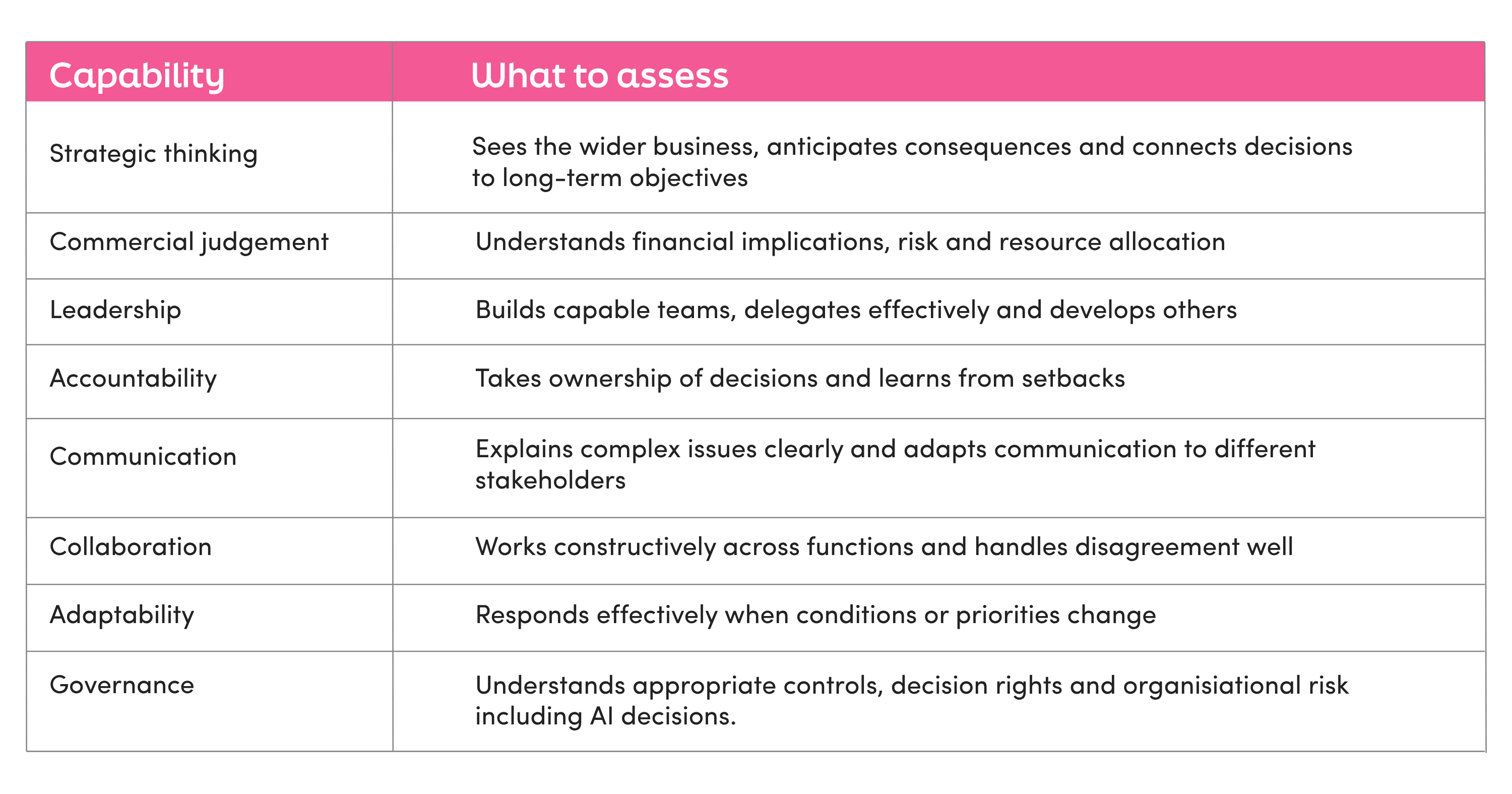
Ask the interview panel to score candidates against the agreed criteria rather than deciding whether they simply liked the person.
A structured process gives you a more consistent basis for comparing candidates and makes it easier to separate interview polish from evidence of capability.
Green Flags in a Senior Interview
Strong senior candidates tend to provide specific examples rather than broad leadership statements.
Look for candidates who:
- explain the context behind important decisions
- give appropriate credit to the people around them
- quantify commercial outcomes where relevant
- acknowledge decisions they would make differently
- distinguish between strategy and execution
- ask thoughtful questions about the organisation
- demonstrate curiosity before proposing solutions
- speak respectfully about previous employers, teams and boards
- explain how they develop capability in others
- understand both the commercial and human consequences of leadership decisions
- can clearly explain their contribution to a team achievement, not just the team's collective achievements.
The quality of the questions a senior candidate asks you can also be highly revealing.
Someone considering a significant leadership role will usually want to understand strategy, financial performance, culture, decision-making, expectations, organisational challenges and why the position is open.
Red Flags to Look For When Interviewing Senior Candidates
Some warning signs deserve closer examination.
These include:
- vague answers with few concrete examples
- excessive reliance on corporate terminology
- claiming personal credit for complex team achievements
- repeatedly blaming previous organisations or colleagues
- difficulty describing failure or learning
- moving quickly to solutions without gathering sufficient information
- confusing senior leadership with operational control
- an inability to explain how success was measured
- reluctance to discuss difficult people decisions
- limited evidence of developing other leaders
One red flag rarely provides enough information to make a decision. Probe further and compare what you hear with references, career evidence and the requirements of the role.
Interviewing Permanent, Fractional And Interim Executives
Not every senior business requirement calls for a permanent executive appointment.
Businesses increasingly use permanent, interim, contract and fractional leadership depending on the problem they need to solve.
The interview needs to reflect the engagement model.
Questions for permanent executives
A permanent senior leader may influence the organisation for many years.
Explore questions around:
- long-term strategic direction
- succession planning
- organisational culture
- leadership development
- stakeholder relationships
- transformation
- governance
- sustainable commercial performance
You are assessing both immediate capability and the leader's ability to grow with the organisation.
Interview questions for fractional executives
A fractional executive often enters the organisation with a clearly defined commercial mandate and needs to add value quickly.
Useful questions include:
How do you diagnose a business you know very little about during your first few weeks?
What information do you request before beginning an engagement?
How do you establish credibility with an existing leadership team?
How do you define success when working with a client for only part of the week?
How do you transfer knowledge and capability to the internal team?
Tell us about a fractional or advisory engagement where the original brief changed once you understood the business.
Strong fractional executives bring experience without creating unnecessary dependency. They can enter quickly, establish priorities, deliver against a defined mandate and leave stronger capability behind.
References Remain an Important Part of Senior Hiring
Senior candidates usually present well in interviews.
References provide an opportunity to test the consistency between the candidate's account and the experience of people who have worked closely with them.
Avoid limiting reference conversations to dates of employment and broad performance questions.
Where appropriate, explore:
- the environment the candidate operated in
- the scale of their responsibility
- how they led under pressure
- how they handled disagreement
- whether they developed other leaders
- areas in which they were particularly effective
- situations in which they struggled
- whether the referee would work with them again
- Specific examples of key achievements of the candidate.
Senior recruitment benefits from triangulation. Interview evidence, career history, references and assessment information together create a more complete picture than any one source alone.
Choosing The Right Senior Leader For Your Business
There is no single perfect executive profile.
The right leader depends on the organisation, the mandate and what the business needs next.
A highly successful corporate executive may not necessarily thrive in an entrepreneurial growth business. A brilliant turnaround leader may not be the right person for a company entering a period of stability and consolidation. A fractional executive may offer exactly the specialist capability required without creating the cost or long-term commitment of a permanent appointment.
The quality of the hiring decision therefore depends on clarity.
Define the outcomes. Establish the capabilities required. Ask consistent, evidence-based questions. Probe beyond rehearsed responses. Then assess the person against the role requirements. Be as objective as possible.
Finding Senior And Fractional Talent
RecruitMyMom’s extensive South African talent network includes experienced senior professionals, specialists and executives available across permanent, fixed-term, independent contracting and fractional appointments.
For global employers, you have access to highly skilled professional talent across a range of working models. Some organisations need a permanent executive to lead their next stage of growth. Others need specialist leadership for a defined period, transformation project or particular business challenge.
Our recruitment team works with employers to understand the business requirement first, then identifies experienced professionals whose skills, experience, availability and preferred working model align with that mandate.
Partner with RecruitMyMom to find senior and fractional talent.
Frequently Asked Questions
What questions should you ask when interviewing a senior executive?
The strongest questions examine strategic judgement, commercial decision-making, people leadership, accountability, change management and governance. Ask candidates for specific examples and probe how they reached important decisions rather than focusing only on the outcome.
How many questions should you ask in a senior interview?
There is no ideal number. The interview needs enough structure to assess the core capabilities required for the role while still allowing thoughtful follow-up questions. A focused set of well-designed questions usually reveals more than a long list covered superficially.
How do you tell whether a senior candidate is genuinely strategic?
Ask for examples of decisions involving competing priorities, long-term consequences and significant organisational trade-offs. Strategic candidates can explain how they assessed the wider business environment, what information influenced their decision and how they connected execution to broader organisational objectives.
How can an interview panel reduce bias when hiring executives?
Define the role criteria before meeting candidates, ask shortlisted candidates the same core questions, use an agreed scoring framework and have interviewers assess evidence against those criteria rather than relying on personal chemistry.
What is the difference between interviewing a permanent and fractional executive?
Permanent executive interviews place greater emphasis on long-term leadership, culture, succession and organisational development. Fractional executive interviews focus more heavily on rapid diagnosis, specialist expertise, stakeholder alignment, defined outcomes and effective knowledge transfer.
What are the biggest red flags when interviewing senior professionals?
Common warning signs include vague answers, limited evidence of personal accountability, excessive jargon, taking sole credit for team achievements, blaming previous employers and proposing solutions before understanding the underlying business problem

